What Panorama is
Panorama is a gateway that sits between your engineers’ coding tools and Amazon Bedrock. It is one container that runs in your own infrastructure.
Engineers point Claude Code, opencode or Codex CLI at it instead of at a model provider. You get sign-in, budgets and a say in which models are used. You also get the part nothing else does: what each branch, ticket and pull request cost, because Panorama reads that context out of the traffic as it passes. Engineers install nothing and configure nothing for that to work.
What happens to a request
Section titled “What happens to a request”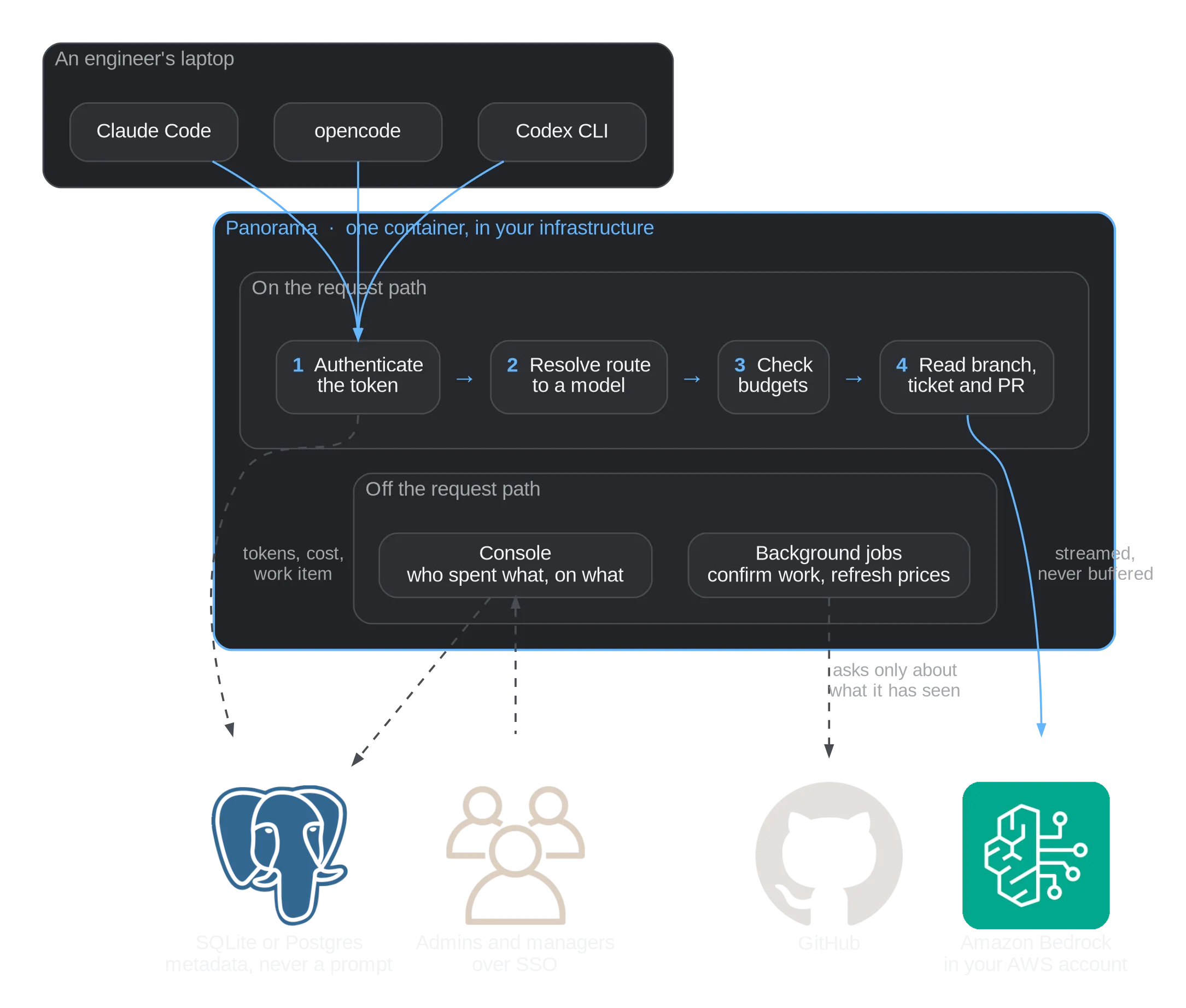
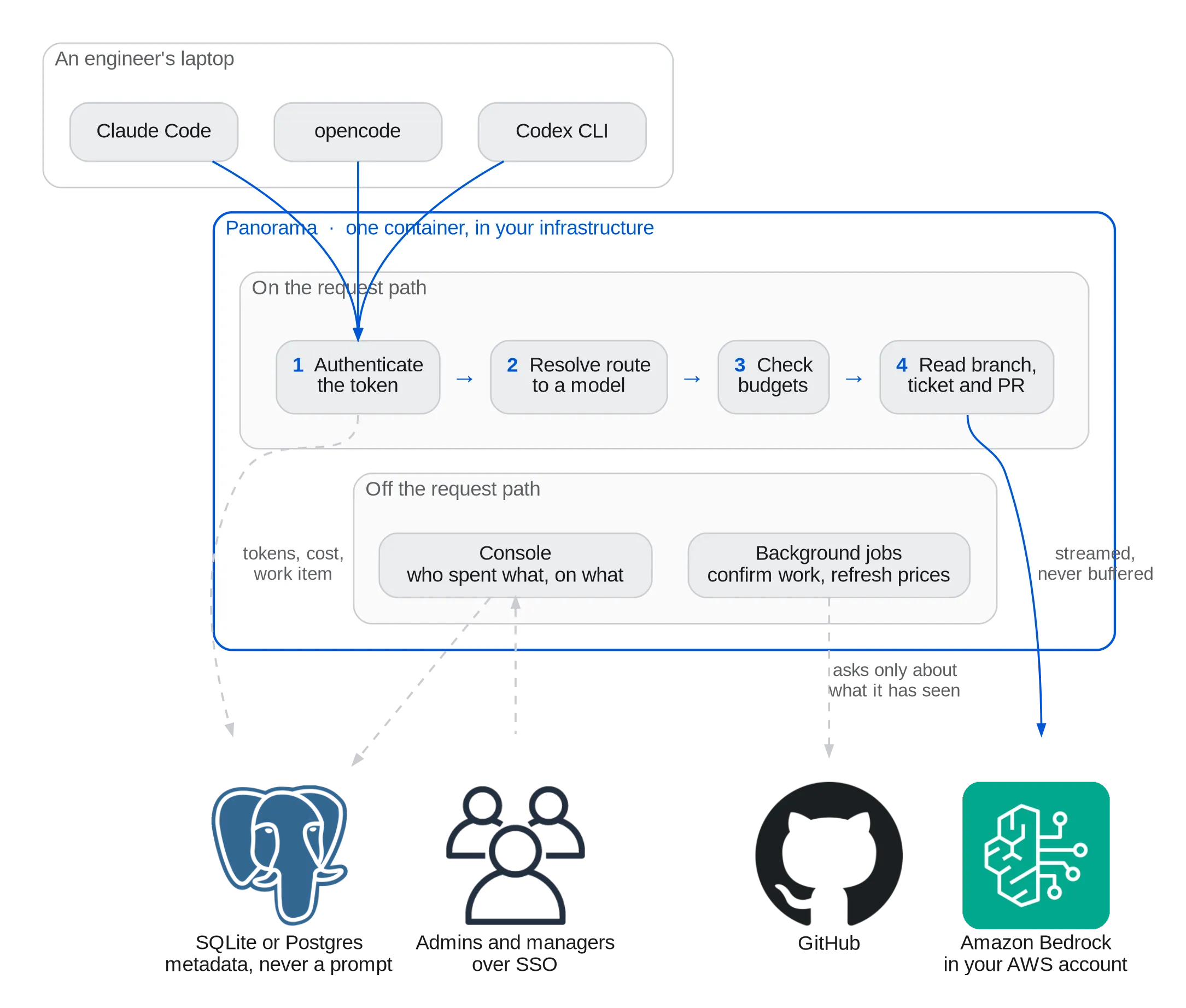
- Authenticate. The tool sends a gateway token. Panorama knows who is asking before it reads anything else.
- Resolve the route. The tool asks for a route, a name you made up such
as
standard. You decide which model that name runs on. An engineer never names a model. - Check budgets. The person’s, their team’s, and the organization’s.
- Read the work context. The repository, branch, ticket and pull request are matched out of the request body in flight. The body is then discarded.
The response streams straight back. Nothing on that path buffers it, and nothing on it touches the database.
If those words are new, Concepts defines each one in a sentence.
What you get
Section titled “What you get”| One governed endpoint | Every request is authenticated, checked against a budget, sent to a model you chose, and recorded. |
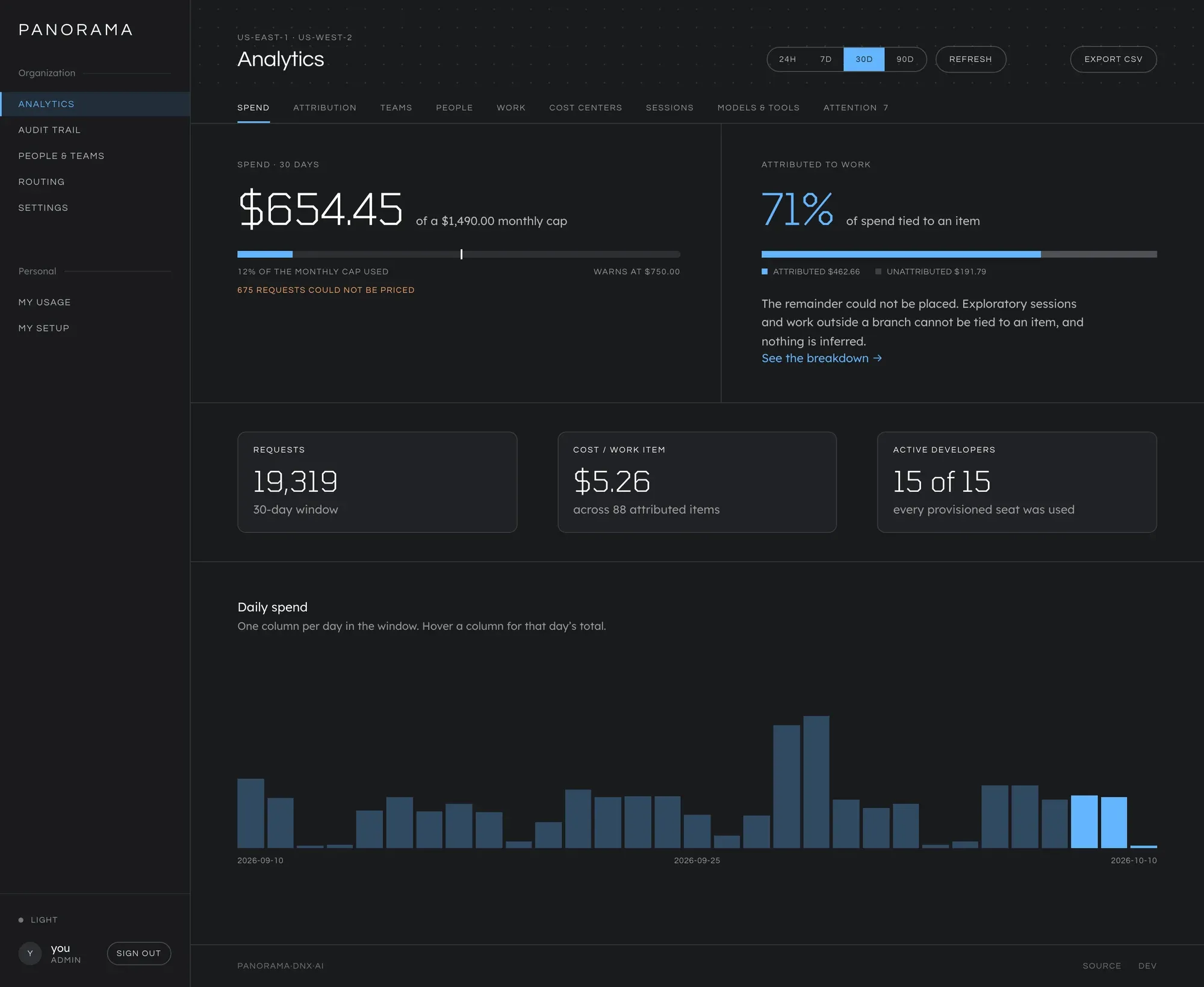
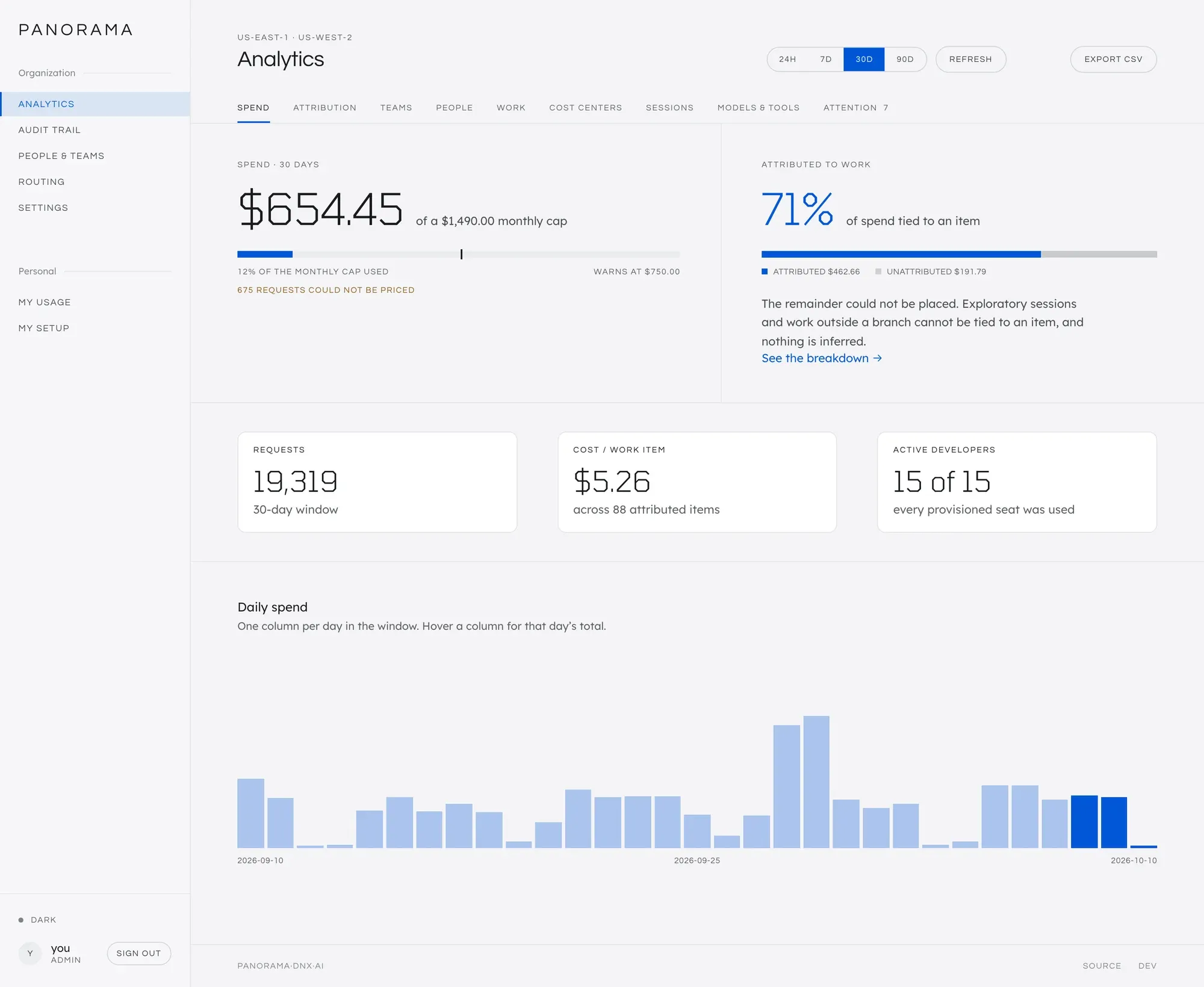
| Cost you can trust | Input, output, cache read and cache write are priced separately, per model and per region. A coding agent is mostly cache reads: price them as input and you overstate the bill several-fold. |
| Cost per branch, ticket and PR | Read from the request in flight, then confirmed against GitHub (experimental). “PAY-1183 cost $18.40, merged.” |
| Budgets that hold | Per person, per team, per deployment, by day, week or month. A soft limit warns and closes the routes you marked as too expensive to keep serving, and tells the engineer which routes still work. A hard limit stops the request and says when it resets. |
| Single sign-on | Generic OIDC for the console. Roles come from your identity provider’s groups. |
| A credential engineers mint themselves | A gateway token from the My setup screen, revocable, good for 30 days. |
Three things it will never do
Section titled “Three things it will never do”These are product commitments, not defaults. A change that breaks one does not get merged.
- Store a prompt or a response. Bodies are pattern-matched in flight and discarded. Only the extracted metadata is kept. There is no audit-log option, debug mode or flag that changes this, and the extraction rules are open source so you can check the claim.
- Show one engineer another engineer’s numbers. Per-person spend exists, and is visible to administrators and to the managers of that person’s teams, because whoever pays the bill needs cost per seat. No screen, API, export or dashboard shows one developer another developer’s usage.
- Hide what it could not attribute. Unattributed spend is shown beside attributed spend everywhere the two appear. An honest 70% beats a false 100%.
And one for the request path: streaming is never buffered. The target is under 10ms added to time-to-first-token. See The hot path.
Which coding tools it works with
Section titled “Which coding tools it works with”| Tool | Status |
|---|---|
| Claude Code | Supported. Attributes work down to the branch and ticket. |
| opencode | Supported. Attributes work to the repository, not the branch. |
| Codex CLI | Supported, over the Responses API. |
| Cline, Continue | They speak an API the gateway serves, and are not set up from the console or covered by the test suite yet. |
| Gemini CLI | Not supported. It speaks Google’s API, which the gateway does not serve. |
| GitHub Copilot | Cannot be proxied. It offers no way to point it elsewhere. |
| Cursor | Partial. Its agent traffic does not go through a custom endpoint, so only part of its spend would be seen. |
Status
Section titled “Status”Pre-release. The gateway, pricing, budgets, routing, attribution, the console and engineer onboarding are built. It has not been through a production deployment yet.
Worth knowing before you plan around it:
- The GitHub integration is experimental. It is built and has not yet been tested against a real GitHub organization. See GitHub integration.
- Command-line sign-in is built and switched off in this release. Engineers use a 30-day token they mint in the console. See Credentials.
- Without single sign-on, the console is signed in to with a token. A gateway token minted where Panorama runs opens the whole console, which is enough to evaluate it, but every account is then created by hand. The Quickstart connects an identity provider first. See Credentials.
- SAML is not implemented. AWS IAM Identity Center therefore does not work as a sign-in provider. See Single sign-on.
- Jira is not in v1, and neither is a Helm chart.
- Service tokens for CI are created through the API. There is no screen for them yet.
Licensing
Section titled “Licensing”Panorama is sponsored and maintained by DNX Solutions.
AGPL-3.0-only. The open-source edition is complete for a single organization: the full gateway, policy engine, analytics, attribution and SSO. Nothing is gated, and nothing stops working until you pay.
An enterprise edition covering multi-organization management, audit export and billed-spend precision from the AWS Cost and Usage Report is planned, under a separate commercial licence. No enterprise code exists yet, and nothing in the open-source edition will move behind it.
SAML is not an enterprise feature. For providers like AWS IAM Identity Center it is the only way to sign in at all, so gating it would gate SSO. When it is built, it lands in the open-source edition.
Contributing means accepting the Contributor License Agreement.
This manual is licensed under CC BY 4.0; code samples in it are part of Panorama and licensed under AGPL-3.0-only.
This manual is licensed underCC BY 4.0. Code samples in it are part of Panorama, licensed under theGNU AGPL v3.0 only.